

Project Description
Negotiations

In Negotiations, Maggie Scott engages with the politics of representation and the experience of being black and British. Edward Said writes of the exile’s ‘double vision’, of the sense of estrangement within their experience of home, the dual sense of belonging and not belonging¹, so Homi K. Bhabha insists in his essay DissemiNation on a double narrative movement as essential to narrating a nation, ‘the nation’s people must be thought in double time’². The contradictory impulses of a nation’s history demand a split narrative, doubles that can never be harmonised rendering national events of celebration into sites of political dispute. This sense of ambivalence and estrangement in relation to nationhood and narratives of belonging can be found in many of Britain’s postcolonial cultural developments, in particular literature but also in the work of visual artists such as Maggie Scott who reflect on the interaction of personal and collective histories and the negotiation of the terms of cultural engagement for both individuals and communities.
Maggie Scott’s textile work Wedding Day pictures this double time in a double aspect image that juxtaposes personal and political, a mixed race ‘white wedding’ (the artist’s parents) and a National Front ‘Keep Britain White’ rally in Trafalgar Square, both events coexistent in the history of the British nation, two national narratives that can never be reconciled.
Wedding Day was the first of Scott’s new body of work that uses a technique of felting printed silks and the beginning of a series of works that move between both personal and communal narratives. The lengthy labour involved in producing her textile works combines with her use of photographs, personal and historic to enact a different kind of cultural temporality, one which emerges from the experience of social marginality. There is not only an urge to reclaim the past but also as Bhabha proposes an attempt at renewal, ‘refiguring it as a contingent in-between space that innovates and interrupts the performance of the present’³. In making the ‘Wedding Day’, Scott felts and stitches only the things she can remember, the sensuous surface of the felted fabric conjuring up touch and bodily presence, drawing in the viewer only to obscure recognisability as the felted surface abstracts the image.
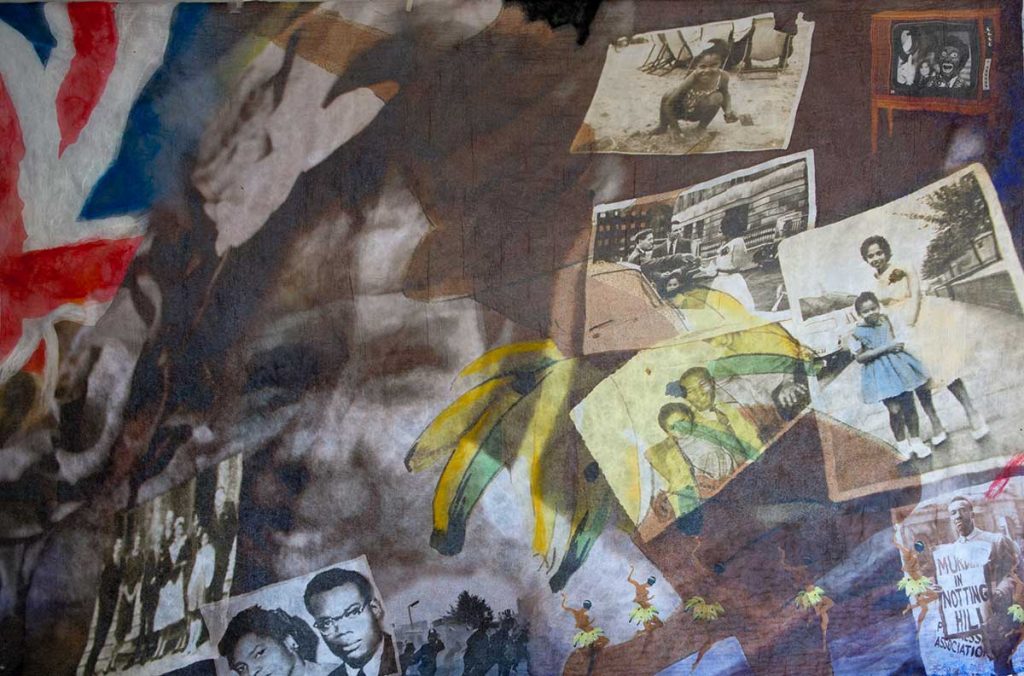
Scott chooses also to reinterpret and reclaim the black female subject in portraiture through focusing on the internal rather than the physical body, on the collective process of calling up memory and shared emotion. In Mixed Messages //1, Scott depicts family photographs as a flow instead of a frozen instant, a fluidity of unfinished histories and emotional connections that resist erasure and the fixity of official history. In the works Mixed Messages //1 and Early Messages //1, Scott also introduces images of blackness fed back to her as a child by British popular culture: Josephine Baker, the Black and White Minstrels, images of how the black community were perceived and images over which they had no control. In contrast, the work No Mirrors presents an image of unofficial history, a portrait of black female connectedness. Scott’s intention is not only to break down the static boundaries of identity but to contest the hierarchies between artist and audience, institution and community by providing points of cultural reference that draw in black audiences to a communal act of remembrance.
Words by Kathy Fawcett
Wedding Day was the catalyst for a series of textiles using photography as a site of memory and therefore the Negotiations series. The work explores some of the contradictions of a Black British identity. Using a photograph of my mother and stepfather’s wedding day printed onto silk, I chose only to felt and stitch only things I could remember, my blue dress, my mother’s corsage, her gloved hands. I am intrigued by the gaze of young Maggie starting out at the viewer and seemingly oblivious to the adults deep in conversation.

Wedding Portrait, Maggie Scott
Josephine, Maggie Scott

Wedding Portrait, Maggie Scott
Moving between personal and communal narratives, with Josephine and Early Messages: Enid Maggie combines family snapshots with the images of black people that were fed to children of her generation by British popular culture: Josephine Baker, the Black and White Minstrels, the Three Golliwogs, these are images of how the black community were perceived and images over which they often had no control.
A portrait of the young Maggie is collaged alongside images of the Union Jack, childhood photographs, a copy of Enid Blyton’s “Three Golliwogs” and a photograph of one of the many Keep Britain White rallies that took place during my early years.


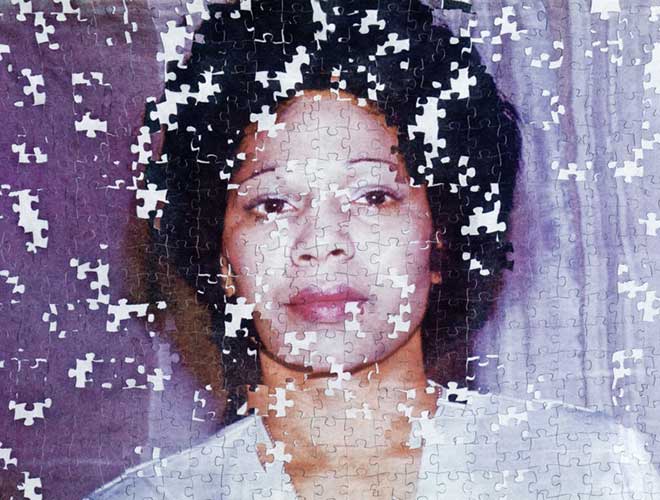

bell hooks articulates the role of photography in the process of decolonisation, in her essay ‘In Our Glory: Photography and Black Life’ by emphasising the necessity of reclaiming the past through the ‘re-membering’ of fragments into a whole.
Towards the end reclaims an identity erased by the social forces of disenfranchisement as much as by mental illness, not only through the photographic image but also the re-presentation of the image through the medium of felting.
The work is both personal and political, the work moves between individual and communal narratives. The gradual fragmentation of four felted jigsaw portraits describes the breakdown of my mother’s mental health before her death, but is also a statement about the over-representation of black people in the mental health system.
– Maggie Scott


